
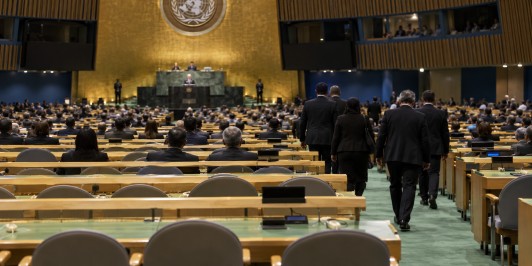
The international stage of the United Nations General Assembly saw tension rise as the United States took a hardline stance on contentious global issues. During President Donald Trump’s address on September 22, representatives from Iran and Cuba walked out in protest. The US President targeted both nations with sharp criticism, highlighting broader geopolitical frictions.
The Iranian delegation exited the assembly hall when President Trump broached the topic of US military operations concerning Iran. Trump’s speech underscored a critical moment for US-Iran relations, warning of potential further actions if a diplomatic agreement with Tehran remained elusive. Iranian President Masoud Pezeshkian and Foreign Minister Abbas Araghchi, present in New York for the session, were notably absent during the speech. Trump called on the international community to amplify economic pressure on Iran, emphasizing a pivotal choice between negotiation and escalation.
Later, representatives from Cuba followed suit, leaving the chamber after Trump’s remarks labeled Cuba as a “failed state.” The President asserted his administration’s commitment to seeing significant changes on the island, declaring that freedom would ultimately prevail in Cuba. He further stated that the US would prevent any foreign adversaries from establishing a foothold there, highlighting ongoing US-Cuba tensions.
These walkouts marked a dramatic moment in Trump’s address, where he outlined his administration’s positions on various international issues to world leaders gathered at the United Nations. The reactions from Iran and Cuba underscored the contentious nature of US foreign policy under Trump’s leadership, as well as the broader challenges confronting international diplomacy.